Sonnet CXV
Those lines that I before have writ do lie,
Even those that said I could not love you dearer:
Yet then my judgment knew no reason why
My most full flame should afterwards burn clearer.
But reckoning Time, whose million'd accidents
Creep in 'twixt vows, and change decrees of kings,
Tan sacred beauty, blunt the sharp'st intents,
Divert strong minds to the course of altering things;
Alas! why, fearing of Time's tyranny,
Might I not then say, 'Now I love you best,'
When I was certain o'er incertainty,
Crowning the present, doubting of the rest?
Love is a babe, then might I not say so,
To give full growth to that which still doth grow?
Comparisons are often made between this sonnet and the love poem by John Donne, Love's Growth, part of which is given below. Lovers Infiniteness by the same poet is also relevant. These poems by John Donne are probably of a similar date to this sonnet, so we may be assured that metaphysical speculations of this sort were current among the literary fraternity of the time.
The poet marvels how his love can still seem to increase, even though in times past he claimed that it was impossible to love with any greater love than he knew at the time. Yet, on looking back, he finds that his love has grown miraculously even beyond that complete measure which he thought was the limit of its fulfilment. He concludes that, since love is a babe, (Cupid), he cannot know how to define himself, or acknowledge any limitations to his growth, even though, as a full and perfect God he can in theory not be any better than he is already.
John Donne LOVE'S GROWTH. c. 1593-1601.
I scarce believe my love to be so pure
As I had thought it was,
Because it doth endure
Vicissitude and season, as the grass;
Me thinks I lied all winter, when I swore
My love was infinite, if spring make it more.
LOVERS INFINITENESSE c. 1593-1601.
If yet I have not all thy love,
Dear, I shall never have it all,
............................
Yet I would not have all yet,
He that hath all can have no more,
And since my love doth every day admit
New growth, thou shouldst have new rewards in store;
Thou canst not every day give me thy heart,
If thou canst give it, then thou never gavest it:
Love's riddles are, that though thy heart depart,
It stays at home, and thou with losing savest it:
But we will have a way more liberal
Than changing hearts, to joyne them, so we shall
Be one, and one anothers All.
The 1609 Quarto Version

THoſe lines that I before haue writ doe lie,
Euen thoſe that ſaid I could not loue you deerer,
Yet then my iudgement knew no reaſon why,
My moſt full flame ſhould afterwards burne cleerer.
But reckening time,whoſe milliond accidents
Creepe in twixt vowes,and change decrees of Kings,
Tan ſacred beautie,blunt the ſharp'ſt intents,
Diuert ſtrong mindes to th' courſe of altring things:
Alas why fearing of times tiranie,
Might I not then ſay now I loue you beſt,
When I was certaine ore in-certainty,
Crowning the preſent,doubting of the reſt:
Loue is a Babe , then might I not ſay ſo
To giue full growth to that which ſtill doth grow.
Commentary
- 1. Those lines that I before have writ do lie,
- Those lines = the other sonnets, written
before this one.
before have writ = have written previously.
do lie - the reason why they have not told the truth is shortly to be stated. - 2. Even those that said I could not love you dearer:
Even those = those especially, those particularly.
I could not love you dearer = I could not love you with a deeper love than that with which I now love you.
dearer = more intensely, more deeply, with more sacred devotion. dearer is usually found in Shakespeare as an adjective of comparison, meaning 'more costly, more expensive, more precious, more grievous'. The only comparable adverbial use is in Julius Caesar:That I did love thee, Caesar, O, 'tis true:
If then thy spirit look upon us now,
Shall it not grieve thee dearer than thy death,
To see thy Anthony making his peace,
Shaking the bloody fingers of thy foes, JC.III.1.195-9.
In fact there are no sonnets which say precisely 'I cannot love you more than I do now'. This has led some commentators to question whether or not there were other sonnets which made this claim, and now are completely lost, to which others commentators have replied that this is a footling and irrelevant question. It is true of course that we do not look for exactitude in poetry, and that the phrase has a general import, which links to statements such as 'You are my all the world', and 'Thou, all they, hast all the all of me'. Nevertheless Shakespeare might well have considered, when writing this, in what way and to what extent it applied to the poems already written. The totality of his love seems not to be in question, and its continuing faith and constancy, which is affirmed in the following sonnet. Yet it also seems to be inherently improbable that these are the only sonnets written by Shakespeare. Given his apparent unconcern with securing his own immortality through the publication of his plays we should not rush to the conclusion that these sonnets are the sum total of his creations in that genre. We would not be justified in such an inference even if we knew for certain that the 1609 Quarto was entirely authorised and seen through the press by the author. We may agree, on balance, that it is not important to relate the words directly to other specific sonnets in the sequence. There is enough in the general tone of the sonnets to satisfy the purport of the words, and there may indeed also have been other sonnets or love poems which said the same thing in different words.- 3. Yet then my judgment knew no reason why
- then
- when I wrote those other poems.
my judgement = my ability to make a sensible judgement, my power of discernment. - 4. My most full flame should afterwards burn clearer.
- My
most full flame - fire and flames
were associated with love. Compare this from Hamlet:
Not that I think you did not love your father;
But that I know love is begun by time;
And that I see, in passages of proof,
Time qualifies the spark and fire of it.
There lives within the very flame of love
A kind of wick or snuff that will abate it; Ham.IV.7.110-15. - 5. But reckoning Time, whose million'd accidents
- reckoning
Time = time, which keeps
account of all human activities. Compare, for example:
But thoughts, the slave of life, and life, Time's fool;
And Time, that takes survey of all the world,
Must have a stop. 1H4.V.4.81-3.and
Time hath my Lord, a wallet at his back
In which he puts alms for oblivion TC.III.3.145-6.But reckoning Time - the opening phrase of this quatrain seems to demand a final statement, instead of a whole list of qualifying phrases. The final effect never seems to arrive, and one is left wondering what it is that reckoning Time is accountable for in relation to this particular instance of the poet's love having grown rather than decreased. The unfinished construction is variously interpreted. For example the word reckoning could be taken as applying to the speaker. He is the one doing the reckoning. Thus: 'giving consideration to Time, whose various activites etc., why then should I not etc.?' (line 9). Or divert in line 8 could be emended to diverts, and this line would then be the predicate phrase of the subject Time in line 5. Thus 'reckoning time, with its many attributes, diverts strong minds etc.' (However this interpretation does not indicate satisfactorily why the fact of diverting strong minds to the course of altering things is significantly or generically different from the other activities of time listed, viz creeping in between vows, changing decrees etc., for they all seem to be as weighty in their import as diverting strong minds). Or one could be contented to allow the pendent construction to remain, as indicative of the disturbed state of mind of the speaker as he realises, while listing time's deleterious effects, that all this would have impinged on his mind in those former times and forced him to make the declarations which he then made of the immensity and completeness of his love, declarations which now he realises were not entirely true.
million'd accidents - millions of chance occurrences. OED suggests that milliond might be no more than a dialect form of million, or formed from the analogy with thousand. - 6. Creep in 'twixt vows, and change decrees of kings,
- creep
in twixt vows = surreptitiously
enter to disrupt sacred vows and promises, either to prevent them being
made, or to ensure that they are broken after they are made. Lovers'
vows
are presumably at the forefront of the poet's mind, especially as there
were so many classic instances in which they were broken. Vows of love
are
frequently referred to in the plays. Compare for example:
I charm you, by my once-commended beauty,
By all your vows of love and that great vow
Which did incorporate and make us one, JC.II.1.171-4.OPH. My Lord, he hath impportuned me with love
In honourable fashion.
POL. Ay, fashion you may call it; go to, go to.
OPH. And hath given countenance to his speech, my Lord,
With almost all the holy vows of heaven.
POL. Ay, springes to catch woodcocks. I do know,
When the blood burns, how prodigal the soul
Lends the tongue vows: Ham.I.3.109-17.change decrees of kings - either by making them ineffectual and irrelevant, or by causing them to be annulled.
- 7. Tan sacred beauty, blunt the sharp'st intents,
- Tan
sacred beauty -The subject
is the million accidents of Time. Tanning in Shakespeare's language was
definitely not a process of beautifying, as it is often so considered
nowadays.
In Sonnet 62 he views his own face
Beated and chopped with tanned antiquity
and finds the sight unflattering. Tanning was a process used to cure and prepare the leather of hides. It required the use of strong solutions containing urine, acids, dyes etc.the sharp'st intents = the most determined purposes and intentions. blunt is often used as a metaphor for the dulling of human appetites and desires. Compare:
Sweet love, renew thy force; be it not said
Thy edge should blunter be than appetite, 56. - 8. Divert strong minds to the course of altering things;
- Cause strong minds and strong purposes to be diverted to flow in altered directions, in accordance with changing circumstances.
- 9. Alas! why, fearing of Time's tyranny,
- Alas why - to be taken with the next line. 'Alas, why should I not, at that time, have said, etc.? (especially as I was fearful of Time's tyranny).'
- 10. Might I not then say, 'Now I love you best,'
-
then -
i.e. at that time, (when I made the declaration).
'Now I love you best' - perhaps reminiscent of :Thou, best of dearest and mine only care, 48
All these I better in one general best. 91
And worse essays proved thee my best of love. 110
But the general meaning is 'Now my love for you is as great as it ever can be.'
- 11. When I was certain o'er incertainty,
- certain o'er incertainty = sure of my love, which was stronger than the uncertainties of time, and able to conquer them. Compare Sonnet 107: Incertainties now crown themselves assured.
- 12. Crowning the present, doubting of the rest?
- Crowning
the present - The subject
is probably 'my love for you', similar to its use in the previous
sonnet:
Or whether doth my mind, being crowned with you
But the antecedent could also be 'I' of the previous line, or 'my certainty' (of the supremacy of my love), or possibly even 'incertainty', which afflicts all moments of all time.
doubting of the rest = uncertain of the future, the rest of time not taken up by this moment. - 13. Love is a babe, then might I not say so,
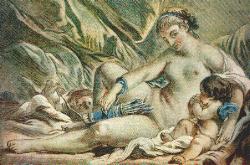 Love
is a babe - the reference
is to Cupid, always depicted as a child alongside Venus. The sequence
of
thought from the previous quatrain to this is not absolutely clear. It
may
be that, in chronicling the change in his love for the youth, and
noticing
its continuous growth, he decides that it must be because 'love is a
babe'
and as such is bound to grow. The mystery is that it always remains a
babe,
yet always grows, as he indicates in the following line. It is
eternally
youthful.
Love
is a babe - the reference
is to Cupid, always depicted as a child alongside Venus. The sequence
of
thought from the previous quatrain to this is not absolutely clear. It
may
be that, in chronicling the change in his love for the youth, and
noticing
its continuous growth, he decides that it must be because 'love is a
babe'
and as such is bound to grow. The mystery is that it always remains a
babe,
yet always grows, as he indicates in the following line. It is
eternally
youthful.
might I not say so = surely I was entitled to say what I said then. Or, as GBE and JK assert, surely I ought not to have said what I said then, where the 'then' has more of the meaning of 'therefore'. Otherwise the argument of the sonnet is meaningless.I think it is impossible to adjudicate between these opposite meanings of the couplet. It is probably deliberately ambiguous, as the poet himself did not know the answer to the question of how love could both be perfect, and full grown, and yet continue to grow.
- 14. To give full growth to that which still doth grow?

See note above. Because love is always growing (still doth grow) yet is always at perfection, it is always at full growth. But, if the second interpretation of the line above is taken, then this one means 'I was wrong at that time to give full growth to Love, (Cupid), since Cupid being a babe is continually growing'.
SB concludes his discussion of this couplet with the following comment:
The ramifications of the couplet and their contradictions of one another might be continued indefinitely. The logical conclusion the sonnet reaches is not expressed in the particular assertion embodied in its last sentence; the point the couplet makes is not in what its words express in relation to one another but in what is demonstrated about all human assertions by its syntactic completeness, its sound of finality, its position at the end of the poem, and its ultimate incapacity to make a final, a definitive, an ultimate, statement. It is impossible to make an absolute statement at any moment in - or about anything that exists in - time. SB.p.384.